

University of Colorado planetary scientist explains more details about lunar H2O
Water has been thought to be on the surface of the moon for decades, most likely in the form of ice.
But a new study, published April 7 in the journal Nature Astronomy, narrows down where this water is most likely and details that water is plentiful on the lunar surface, according to a press release from the University of Colorado Boulder on Tuesday.
The study said water likely accumulated on the moon slowly over billions of years rather than during one big event or impact, such as a comet or asteroid strike.
Furthermore, observations from NASA missions and other sources have provided hints that water might be plentiful on the moon.
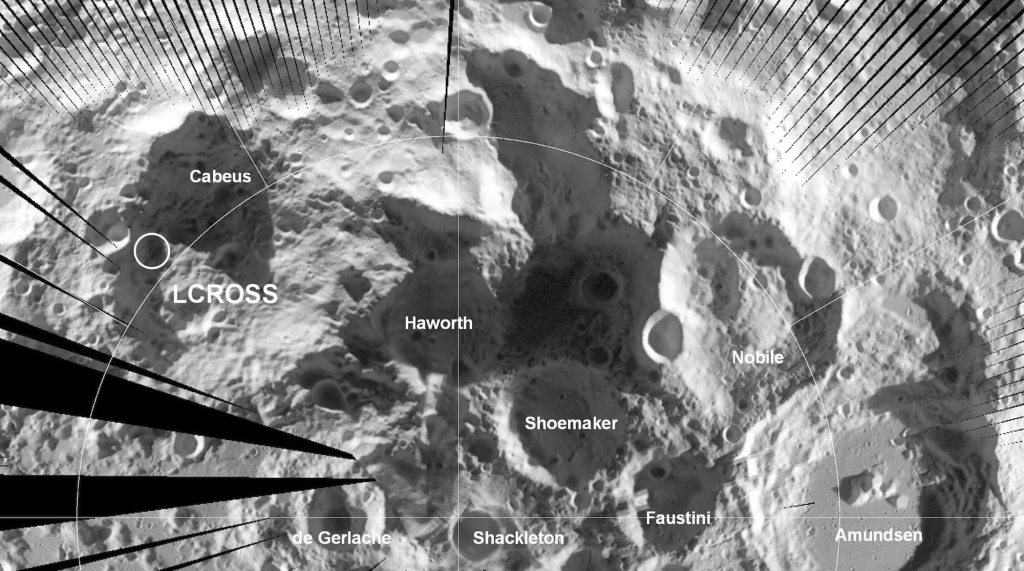
According to the study, water gathers as ice in the deep, dark craters around the moon’s South Pole.
But how the water got to the lunar surface, and why does water seem to exist in some craters but not others, are questions that have been puzzling scientists digging at the “is there water on the moon” question for decades.

Where did the water come from?
The researchers’ findings, including input from University of Colorado Boulder associate professor Paul Hayne, a planetary scientist at the Laboratory for Atmospheric and Space Physics (LASP), can’t pin down the exact source, but they rule out a few possibilities — including water arriving on the moon at once on a humongous comet crashing into the lunar surface.
“It looks like the moon’s oldest craters also have the most ice,” said Paul Hayne, an associate professor in the Department of Astrophysics and Planetary Sciences at CU Boulder. “That implies the moon has been accumulating water more or less continuously for as much as 3 or 3.5 billion years.”
Hayne also said water on the moon would be a goldmine for astronauts.
According to Hayne, future lunar explorers could mine ice for drinking water, or even to produce rocket fuel, by splitting apart the hydrogen and oxygen atoms.
Oded Aharonson, a planetary scientist at the Weizmann Institute of Science in Israel and the stduy’s lead author, said finding water beyond Earth in liquid and usable form is one of the most important challenges in modern astronomy.
Hayne said there are several possible sources for the moon’s water:
- Volcanoes in the distant past may have transported water from deep inside the moon to its surface.
- Water may have also traveled to the moon on comets or asteroids, and it may have arrived via solar wind — a steady stream of charged particles that flows away from the sun and into the solar system.
“Through the solar wind, a constant stream of hydrogen bombards the moon, and some of that hydrogen can be converted to water on the lunar surface,” Hayne said.
Scientists are fairly certain ice built up in what are known as “cold traps” or craters on the lunar surface that exist in permanent shadow and haven’t seen the sun for, in some cases, billions of years.
Observations from the Lyman Alpha Mapping Project (LAMP) instrument on NASA’s Lunar Reconnaissance Orbiter (LRO), which launched in 2009, found evidence of what might be ice in some of those craters, according to the study.
“What’s clear is that the ice has a patchy distribution,” Hayne said. “It’s not concentrated in the same quantities in every crater. And there was no great explanation for that.”
Hayne, Aharonson and the study’s third co-author, Norbert Schörghofer, wanted to come up with an explanation — and in order to do that, they had to rewind the moon’s history.
The team used lunar surface temperature data from LRO’s Diviner instrument and a series of computer simulations to estimate the evolution of craters on the lunar surface.
Hayne said the moon has not always sat in the orientation it is currently in today.
“Instead, its tilt relative to Earth has shifted over time,” he said. “As a result, craters that are in shadow today may not always have been in shadow.”
The researchers came up with a list of the moon’s cold traps after running simulation that have been darkest the longest.
According to the researcher’s findings, the moon’s Haworth Crater, which sits near the South Pole, has likely been in shadow for more than 3 billion years.
“It’s a top candidate for storing a lot of ice,” Hayne said.
The team also discovered something intriguing. The moon’s oldest and darkest craters are also where LAMP had seen the greatest signs of ice.
“Ultimately, the question of the source of the moon’s water will only be solved by sample analysis,” Hayne said. “We will need to go to the moon to analyze those samples there or find ways to bring them from the moon back to Earth.”
Hayne said researchers need to collect more detailed observations of craters on the moon that may harbor ice, and that he’s developing a new instrument to do that called the Lunar Compact Infrared Imaging System (L-CIRiS), which NASA plans to deploy near the moon’s South Pole in late 2027.
Discover more from Rocky Mountain Journal
Subscribe to get the latest posts sent to your email.


