
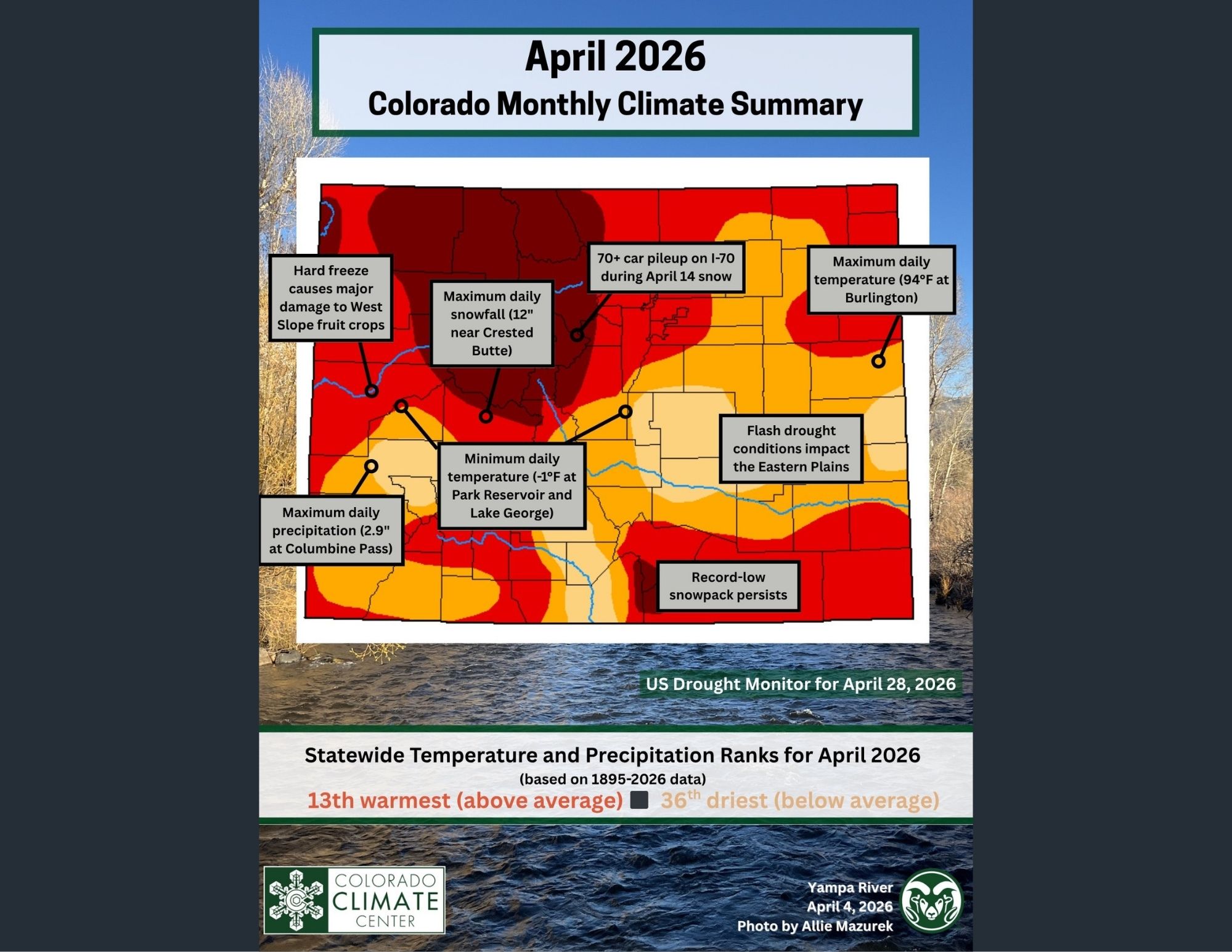
Statewide temperatures were the 13th warmest on record, with cooler and wetter conditions occurring after record-breaking March
The Colorado Climate Center (CCC) released its monthly climate summary on May 8 and it showed April’s weather around Colorado featured some unusual highlights.
Above-average temperatures were recorded in approximately 75% of the state making April 2026 the 13th warmest April on record.
However, average temperatures were nearly a degree cooler than March 2026, which was the warmest March on record, according to the CCC.
A bit more rain and snow fell in April but still continued to add to record dryness throughout the winter season.
Western Colorado recorded pockets of above-average precipitation while eastern Colorado saw large swaths of below-average precipitation. April 2026 was the 36th driest April on record, according to the CCC.

Snowpack melt slowed throughout the month as well due even though temperatures were above-average. Compared to March’s well above-average temperatures and late-month heat wave.
Snowpack remained at record low levels as of the end of April, with all of the state’s mountain ranges far below average. Statewide, the snow water equivalent was just 19% of the 30-year median value as of the end of April.

Notable highlights in April:
- Maximum daily snowfall – 12″ near Crested Butte
- Maximum daily precipitation – 2.9″ at Columbine Pass
- Minimum daily temperature – -1°F at Park Reservoir and Lake George
- Maximum daily temperature – 94°F at Burlington
- 70+ car pileup on Interstate 70 during April 14 snow
April 2026 was 3.4°F warmer than the 20th-century average and 2.3°F warmer than the 1991-2020 average, according to the CCC summary.
Statewide average temperature has been 7.4°F higher than the 20th century average, 5.7°F above the 1991-2020 average, and 2.7°F warmer than any previous October through April period.
Statewide precipitation levels were 0.58” below the 30-year average. “Water year 2026 continues to be the warmest on record by a large margin,” CCC said. “It is the 7th driest start to a water year, 2.77” below average for precipitation statewide.”
April was not as exceptionally warm and dry as March, precipitation deficits continued to mount, according to the CCC. After heavy precipitation fell in October 2025, a deficit began to build through late fall and winter, and continued into early spring.

Not only was prolonged warmth an issue, dry weather led to quickly-intensifying drought conditions over the past month, especially in eastern Colorado, according to the CCC.
As of April 28, the entire state was experiencing drought conditions, with over half the state experiecing D3 (extreme) drought conditions or worse.
Discover more from Rocky Mountain Journal
Subscribe to get the latest posts sent to your email.


