
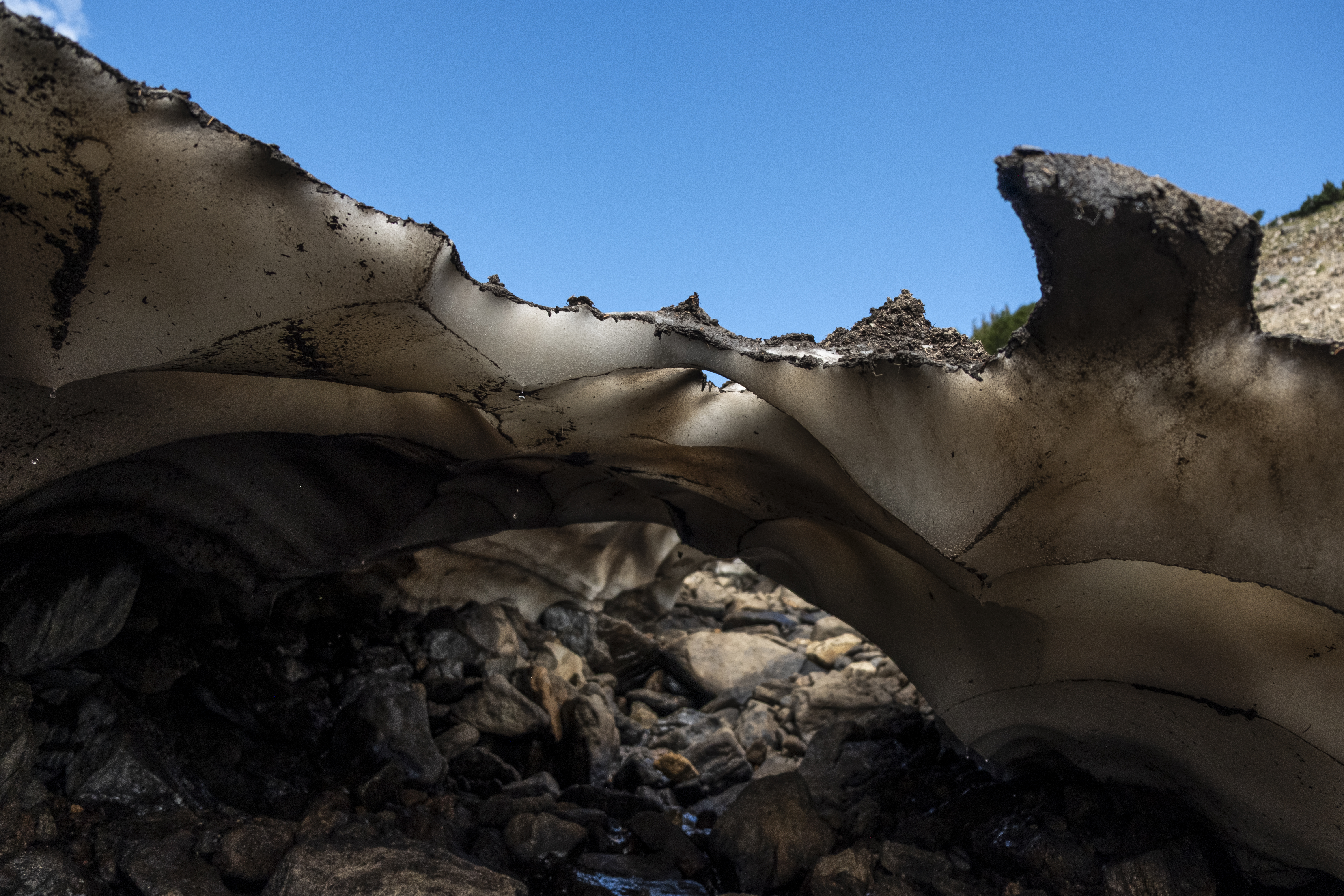
“The upper third of the ‘glacier’ has broken apart from the rest. This is at least four weeks earlier than this has happened before”
Twelve miles northwest of Idaho Springs, Colorado sits a large, year-round snowfield on the lower eastern slopes of James Peak in the Arapahoe National Forest named Saint Mary’s Glacier.
For several decades, the snowfield has been a go-to spot for skiers and snowboarders looking to make turns during the summer months.
But skiers and riders have a problem; the glacier is melting out quicker and more often.

Avid skier, Golden resident and author of “Hunting Powder: A Skier’s Guide to Finding Colorado’s Best Snow,” Jordan Lipp has been skiing Saint Mary’s Glacier since the 1990s, and currently has skied at least one day every month (not all at the glacier) since September 2009; an impressive 203 months.
He also has been observing and recording how much the glacier is melting, or not melting, during the summer and fall months for 30 years. He created a detailed spreadsheet with over a dozen data analysis points tracking the ‘health’ of the glacier.
“I’ve been keeping records of the size of Saint Mary’s Glacier consistently from 2004 to present (and intermittently before then,” Lipp said in a Facebook post on Seth’s Weather Group page on July 14. “I’ve done this at least a couple times every summer and fall.”
Lipp visited Saint Mary’s Glacier on July 1 with his kids in order for them to get their July ski day in, but Lipp found some startling news upon arrival.

“The upper third of the ‘glacier’ has broken apart from the rest,” he said. “This is at least four weeks earlier than this has happened before. The fact that Colorado’s most popular, most visited, smallest, and lowest elevation glacier (at least named as a glacier in the USGS maps) will likely melt out this summer or early fall strikes me as an important topic.”
2026 is the earliest collapse on record
Lipp has been using an ordinal methodology that tracks snow and ice melt at St. Mary’s Glacier, with his first recording at the snowfield from Oct. 29, 1996.
Lipp’s analysis tracks the first date each summer he rated the snowfield either: “Small” (4), “Very Small” (3), or “Extremely Small” (2), and 2026 blows past every prior year by more than a month at every threshold.
Threshold Timing
| Threshold first reached | Previous earliest on record | 2026 |
|---|---|---|
| “Small” (4) or lower | Aug. 10 (2022) | July 1 — over 5 weeks earlier |
| “Very Small” (3) or lower | Aug. 2 (2022) | Aug. 2 — ties 2022 for earliest |
| “Extremely Small” (2) or lower | Oct. 3 (2018, 2021) | Aug. 16 — over 6 weeks earlier than any prior year |
According to Lipp’s analysis, by mid-August, the snowfield had already degraded to a condition it historically didn’t reach until early October, roughly a six-week acceleration in a single season compared to the previous record.
Rocky Mountain Journal Editor Jonathan Ingraham hiked to Saint Mary’s Glacier on Aug. 25 to witness what Lipp had observed nine days prior.

Ingraham found the middle section of the glacier was broken into five pieces: one large piece, three medium small pieces and one small piece, each covered with rocks and dirt, all melting with two of the larger pieces having melt water carving small channels on top of the snow and ice.
Ingraham noted the lower (just above St. Mary’s Lake) and upper (at the top of the drainage) sections of the glacier were completely melted out.

Like Lipp, Ingraham has skied several summer months on the snow and ice fields of Saint Mary’s Glacier, and he too was shocked to see how little snow was remaining before September.
“I’ve skied Saint Mary’s in September before, and it had just enough snow to make it skiable, but I was telling Jordan over email, I don’t think you’ll want to ski it for your September day. It won’t be there.”
The 30-year trend: A clear, sustained decline
Lipp’s spreadsheet also standardizes conditions to a comparable date each year, closest observation to Sept. 15, and computes a 5-year rolling median rating:
- 1997–2011: Rolling median held steady at 5 (“Normal”), dipping only briefly to 4.5.
- 2012–2013: Median fell sharply to 3.5.
- 2014–2026: Median has held at 3 (“Very Small”) essentially every year since — a full 20-year window with no recovery back toward “Normal.”
Lipp’s analysis shows the glacier’s typical late-summer condition dropped two full rating categories between 2012 and 2014 and has stayed there for over a decade.

Month-by-month: Fall is disappearing fastest
Lipp’s “Monthly Comparison” section sheet splits the record into earlier vs. recent years and compares typical conditions by month:
- September: Earlier years were rated “Normal” 75% of the time, with zero “Very Small” ratings. Recent years are rated “Very Small” 71% of the time, with “Normal” dropping to just 14%.
- October: Earlier years were never worse than “Very Small.” Recent years hit “Extremely Small” 44% of the time and are never rated “Normal.”
- July: Comparatively stable, still “Normal” in over 90% of recent observations, suggesting the decline is concentrated in the shoulder season, not high summer. The snowfield still starts each summer close to normal, but the melt is arriving faster and the recovery window before winter is closing.

What’s driving the faster melt
Lipp’s spreadsheet cross-references its own ratings against the Berthoud Summit SNOTEL site’s, a nearby high-elevation weather station, climate data, and found three key drivers of faster melting.
- Melt degree days (May 1–Sept 15) is the strongest driver, with an exploratory correlation of r = -0.46 — more accumulated warm-weather melting correlates with a worse September rating.
- Summer average temperature shows a moderate correlation, r = -0.34.
- April 1 snow water equivalent (winter snowpack) shows only a weak positive correlation, r = 0.28 — meaning winter snow totals matter less than how hot and how long the summer melt season runs.
- Summer precipitation shows essentially no correlation, r = -0.006.

The spreadsheet’s methodology notes the rating scale is ordinal, not a precise measurement, and the Berthoud Summit SNOTEL site is a nearby proxy station rather than an on-site sensor. The spreadsheet data and SNOTEL data should be viewed as exploratory correlations, not proven causation.
Will it ski or ride before the first snow?
Based on Lipp’s ordinal readings and eye witness accounts, chances of being able to ski or ride Saint Mary’s Glacier during the remainder of summer and before the first snow is more or less 0%.

Winter 2025/26 was the warmest on record for Colorado, leading to the state’s worst-ever snowpack.
Combine the worst-ever snowpack with the March heat wave and the recipe was set for Saint Mary’s to potentially melt out completely by summer’s end and/or before the first snow fall of winter 2026/27.
Discover more from Rocky Mountain Journal
Subscribe to get the latest posts sent to your email.


